
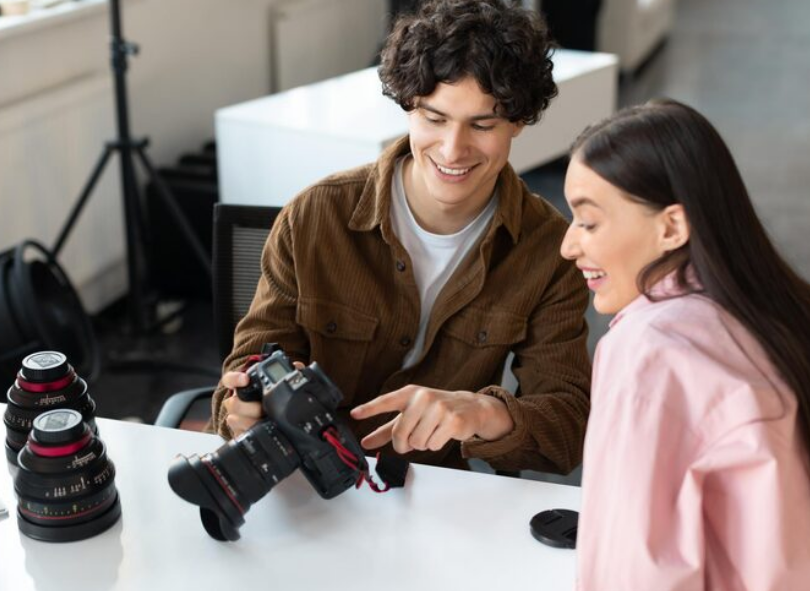

Camera education helps beginners and aspiring photographers understand how cameras work, how to control exposure, and how to create better photographs. Learning photography is not only about owning an expensive camera. It involves understanding composition, lighting, focus, lenses, camera settings, and practical shooting techniques. With the right knowledge and consistent practice, beginners can gradually move from automatic settings to confidently controlling their camera.
What Is Camera Education?
Camera education is the process of learning the technical and creative skills needed to use a camera effectively. It can include basic camera operation, photography principles, composition, lighting, lens selection, exposure, editing, and visual storytelling.
Camera education can be useful for hobby photographers, students, content creators, travelers, professionals, and anyone interested in improving their photography skills.
Understanding the Basic Camera Controls
Before exploring advanced photography techniques, beginners should become familiar with the main controls on their camera.
Important settings include:
- Shutter speed
- Aperture
- ISO
- Focus modes
- White balance
- Exposure compensation
- Shooting modes
- Metering modes
Understanding what each setting does makes it easier to control the appearance of an image instead of relying entirely on automatic modes.
The Exposure Triangle
One of the most important concepts in photography is the exposure triangle. It consists of shutter speed, aperture, and ISO.
Shutter Speed
Shutter speed controls how long the camera sensor is exposed to light. A faster shutter speed can help freeze movement, while a slower shutter speed can create motion blur.
For example, sports photographers often use fast shutter speeds to capture rapidly moving subjects.
Aperture
Aperture controls the opening inside the lens. It affects both the amount of light entering the camera and the depth of field.
A wider aperture can create a shallow depth of field, helping separate a subject from the background. A narrower aperture can keep more of a scene in focus.
ISO
ISO affects the camera sensor’s sensitivity to light. Increasing ISO can help when photographing in darker environments, but high ISO settings can introduce more visible image noise.
Learning how these three controls interact is an essential part of developing camera skills.
Learning Composition
Technical settings are only one part of photography. Composition determines how subjects and visual elements are arranged within the frame.
Beginners can study techniques such as:
- Rule of thirds
- Leading lines
- Symmetry
- Framing
- Negative space
- Balance
- Patterns
- Perspective
- Depth
Good composition can make an image easier to understand and more visually interesting.
However, photography rules are guidelines rather than strict requirements. As photographers gain experience, they can experiment with different approaches.
Understanding Camera Lenses
Different lenses can produce different perspectives and are suited to different types of photography.
A wide-angle lens can be useful for landscapes, architecture, and interiors. Standard lenses are versatile for everyday photography, while telephoto lenses can help photographers capture distant subjects.
Macro lenses are designed for close-up photography, while portrait photographers may prefer lenses that provide flattering perspectives and attractive background separation.
Learning how focal length affects perspective and framing can help photographers choose the appropriate lens for a particular situation.
The Importance of Lighting
Lighting has a major effect on photography. The same subject can look very different depending on the direction, intensity, and quality of light.
Natural light is an excellent starting point for beginners. Photographers can experiment with morning light, evening light, window light, shade, and backlighting.
Artificial lighting can also be introduced as skills develop. Continuous lights and flashes can provide greater control in studio and indoor environments.
Camera Education for Beginners
Beginners do not need to master every camera setting immediately. A simple learning process can be more effective.
Start by learning basic controls and then practice one concept at a time. For example, spend several photography sessions experimenting with shutter speed before moving on to more advanced techniques.
Taking the same subject at different settings can help demonstrate how each adjustment changes the final image.
Photography Practice Exercises
Practice is one of the most effective ways to improve camera skills. Beginners can create simple photography exercises such as:
- Photograph the same object from different angles.
- Take portraits using different lighting conditions.
- Photograph moving subjects with different shutter speeds.
- Experiment with shallow and deep depth of field.
- Photograph a landscape using different focal lengths.
- Practice composing images using leading lines.
- Compare photographs taken at different ISO settings.
Reviewing the results after each exercise can help identify patterns and mistakes.
Camera Education for Content Creators
Content creators can benefit from understanding cameras even if photography is not their primary profession. Product photography, social media images, YouTube videos, website content, and promotional material all depend on visual quality.
Creators should learn basic exposure, focus, framing, lighting, and color management. These skills can improve both photographs and video production.
Learning Photography Through Courses and Tutorials
Photography can be learned through classroom courses, online programs, books, workshops, video tutorials, and independent practice.
A structured course may be useful for someone who prefers a clear curriculum. Online tutorials can provide flexibility, while photography workshops can offer hands-on experience.
When selecting a course, consider the instructor’s experience, curriculum, practical assignments, equipment requirements, course level, and student reviews.
Camera Education and Photo Editing
Photography education increasingly includes basic post-processing. Editing software can be used to adjust exposure, contrast, color, cropping, sharpness, and other aspects of an image.
Editing should generally support the photographer’s original intention rather than compensate for fundamental shooting problems. Learning to capture properly exposed and well-composed images first provides a stronger foundation for editing.
Choosing a Camera for Learning
Beginners do not necessarily need the most expensive camera. Entry-level mirrorless and DSLR cameras can provide manual controls and interchangeable lenses that allow students to practice important photography concepts.
Smartphones can also be valuable learning tools because they allow beginners to practice composition, lighting, framing, and visual storytelling without purchasing additional equipment.
The most important factor is often how regularly the equipment is used rather than how expensive it is.
Building Long-Term Photography Skills
Camera education is an ongoing process. As photographers gain experience, they can explore specialized areas such as portrait photography, landscape photography, wildlife photography, street photography, product photography, sports photography, architecture, and documentary work.
Creating personal projects can also encourage consistent practice. A photographer might document a local neighborhood, photograph changing seasons, or create a series based on a particular theme.
Final Thoughts
Camera education combines technical knowledge with creativity and regular practice. Understanding exposure, lenses, lighting, composition, and focus gives photographers greater control over their images. Beginners can start with basic camera settings and gradually develop more advanced skills through practical exercises and experimentation. Whether photography is a hobby, creative pursuit, or professional goal, continuous learning can make the process more rewarding.
Frequently Asked Questions
What is camera education?
Camera education is the process of learning how to operate a camera and understand photography concepts such as exposure, composition, focus, lighting, lenses, and image editing.
Can beginners learn photography?
Yes. Beginners can start with basic camera controls and gradually develop their skills through tutorials, courses, practice, and photography exercises.
What should I learn first in photography?
Start with exposure, including shutter speed, aperture, and ISO. Then learn composition, focus, lighting, and lens selection.
Do I need an expensive camera to learn photography?
No. Beginners can learn many important photography concepts using smartphones or affordable cameras with manual controls.
Is camera education useful for video creators?
Yes. Understanding exposure, lenses, lighting, focus, and composition can also help people who create videos for websites, social media, and other platforms.
How long does it take to learn photography?
Basic camera skills can be learned relatively quickly, but developing advanced photographic judgment takes regular practice and experience. Progress depends on how frequently someone studies and photographs different subjects.
Read More :5 Major Benefits of a Structured Classroom Environment
